
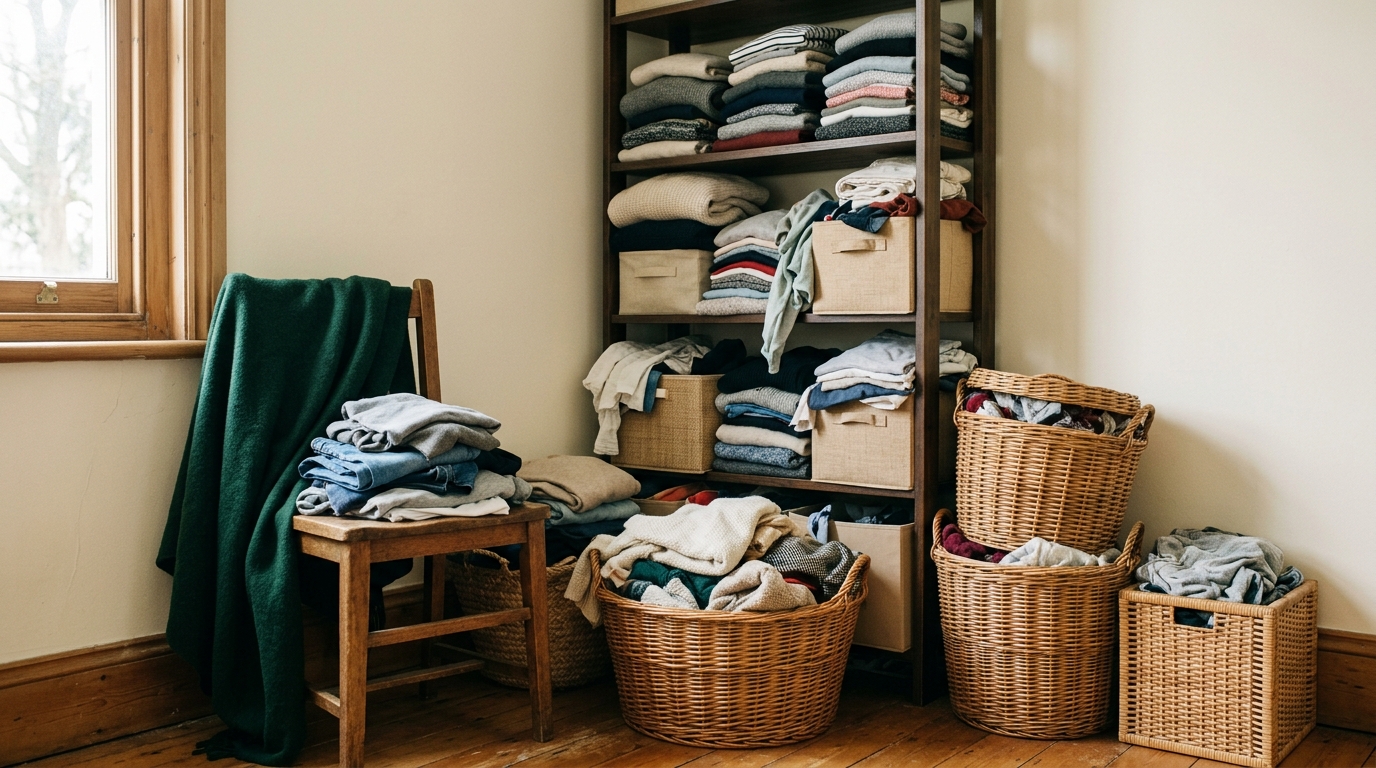
Before another woven basket lands in your cart, it’s worth finding out what that basket is supposed to fix.
Here is how it usually goes. Your room is small and messy, so you set out to buy one storage basket. A nice woven one, the kind that makes a corner look like it has its life together (and the ‘most affordable’). You come home with four. Three weeks later the baskets are full, the room is exactly as messy as before, and the mess now has a lovely texture and color.
I have nothing against baskets. The trouble is what we ask of them. A basket organizes what you already own. It doesn’t make anything disappear, it doesn’t make the room bigger, and it has no opinion on whether you still need the four phone chargers that fit no phone you currently own. Mostly, a basket is a very polite way of saying I’ll deal with this later, and a lot of small room mess is just a collection of postponed decisions that has been given a nicer outfit.
So here is the argument of this whole post, stated plainly. A messy small room isn’t one problem. It’s three different problems that look identical from the doorway, and a basket helps with only one of them, some of the time. Until you know which problem you have, shopping for storage is guessing with a receipt.
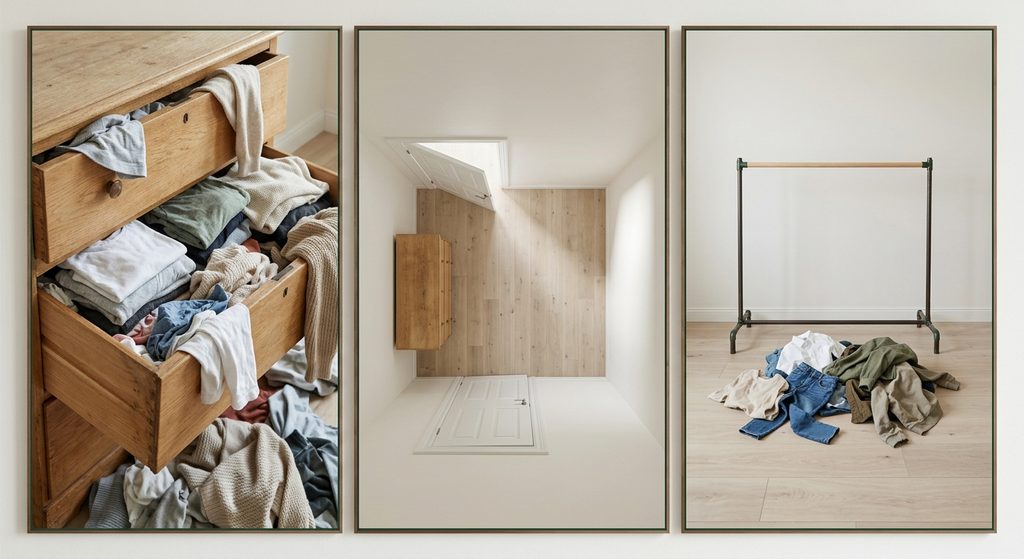
Three problems wearing the same messy outfit
Walk into any cramped, cluttered room and you’ll see the same scene: things, mostly clothes on the chair, stuff on the floor, stuff on top of the stuff. But the reason it’s there can be very different, and so can the fix.
Problem one: there’s too much stuff for the room
The symptoms are easy to spot: drawers that close only if you lean on them with your hip, clothes piled on top of the wardrobe because the closet has stopped accepting them, and a shelf holding two layers of things where the back layer remains a complete mystery. If you have ever bought a basket just to hold your other baskets, this is probably you.
There’s a quick test. Try putting something back where it lives. If it only fits when you squash it, the room isn’t messy; it’s full. Those are different conditions, and they don’t have the same cure.
This is where baskets quietly make things worse. A container gives clutter an official address. Once something has a basket, it feels settled, and things that feel settled tend to stay for years. You’ve turned a pile you might have noticed into a tidy object you’ll walk past forever.
The fix is the unglamorous one: let the space set the limit. Pick a shelf, a drawer, or a rail and decide that this is how much of that thing the room can hold. When it’s full, something leaves before anything new moves in. Go for the easy candidates first: duplicates, broken things waiting for a repair that isn’t coming, and the just-in-case items you could replace cheaply if you ever really needed them. A spare cable that costs a couple of dollars and a short walk to replace is not a family heirloom.
There is a real trade-off here, and it’s worth being honest about it. Sometimes you’ll let something go and need it six months later. That happens, and it often costs less than the space you spent all that time giving up for it. Sentimental things are a different category, and no rule about full shelves should be turned against them. Give them a small, protected spot and leave it at that.
Problem two: the layout is working against you
Here the room could hold your things, but the way it’s arranged makes using it a hassle. You might have an empty corner nobody touches, a door that opens halfway because of a dresser, a bed that blocks the wardrobe, or one spot where things pile up every single week. That pile is a clue. It marks the exact place where your routine needs a hook, a shelf, or a tray and doesn’t have one. (If your pile lives on a chair, congratulations, you’ve found the most honest piece of furniture in the room.)
In a small room, convenience matters more than capacity. If putting something away takes more than a few seconds, or means moving something else first, it won’t happen consistently, and the pile wins. You can own a perfectly reasonable amount of stuff and still live in a mess because the things you use daily are stuck behind the things you use yearly.
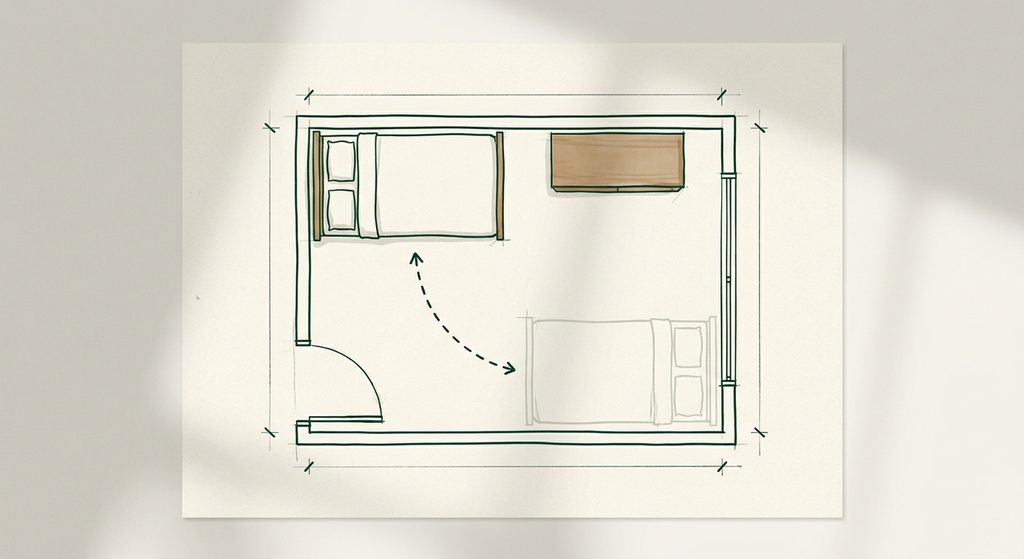
Rearranging costs nothing but effort, so try it before spending money. Put daily things at hand height, close to where you use them. Push the things you need twice a year to a high shelf or the back. Look at whether a piece of furniture is wasting space, like a bed that could sit lengthwise or a chair that could simply leave. Sketch the room on paper with measurements before moving anything heavy. In a very small room there may be only one arrangement that works, and it’s much kinder to your back to discover that on paper.
Problem three: there really isn’t enough of the right storage
This is the only one where buying actually helps. You’ve sorted, you’re keeping a reasonable amount, and some things still have nowhere sensible to go. Maybe there’s no hanging space at all, or nowhere for shoes, or your books live in a leaning tower on the floor.
Even here, the word right matters. Things that hang need a rail. Folded things need a shelf or a drawer. Small loose things need a container. Heavy things want to be near the floor. A basket is one kind of loose container, and it makes a poor substitute for a rail. Before buying anything, work out what exactly has no home, how much of it there is, and where the new thing will stand. Measure the space, not just the item. Then check whether something you already own could do the job, like a sturdy box, a crate, or a suitcase under the bed.
Same small room, different problem
These problems show up differently depending on how you live, so take three common situations.
A bedsitter with no built-in wardrobe. This is mostly problem three, with a little of problem one on the side. Clothes need somewhere to hang, and if you’re renting, you may not be allowed to drill into the walls. A freestanding clothes rail or a slim standalone wardrobe solves the main issue, and hooks on the back of the door can take the daily items. An open rail shows everything, which looks lovely only if you keep it edited. A closed wardrobe hides the mess but costs more and takes floor space. For out-of-season things, lidded boxes under the bed make sense. Vacuum bags save a lot of room with bulky items, but they can leave things creased and don’t suit every fabric, so test one before you commit your whole winter collection.
A family sharing a few cupboards. Here it’s problem one with a negotiation layered on top. Everyone’s belongings compete for the same shelves, and the tidiest person slowly loses space to the least tidy one. Giving each person a clearly marked zone, even if it’s one shelf or one bin each, takes the arguing out of it. This is where baskets finally earn their keep, not as hiding places but as limits: when your basket is full, it’s full. Put children’s zones low enough for them to reach, because a perfect system above a child’s head only works on adults. Shared things like spare bedding and cleaning supplies get their own labeled spot. It’s worth admitting that this is as much about agreeing on rules as it is about storage, and no purchase will do that part for you.
A small apartment with awkward furniture. This is mostly problem two. The dresser that stops the door from opening, the sofa that blocks the only usable wall, the bed that eats half the floor. Before buying anything, draw the room to scale on paper and try different layouts there. Then ask the uncomfortable question: is one big piece of furniture the real problem? A heavy chest of drawers that’s half empty, or a bulky chair nobody sits in, can take up room that a few well-chosen shelves would use better. Selling or giving away one oversized piece sometimes gives you more storage than any shopping trip. The trade-off is that you might want something similar later, so think honestly about whether you’d actually replace it.
When a basket is the right answer
Baskets are not the villain. They work well when they have a specific job. As a limit, like the family zones above. As a landing spot for things that come and go, like keys and mail. For children’s toys, where being able to clear the floor in one sweep matters more than a clever system. And on open shelves, where how things look is part of the point.
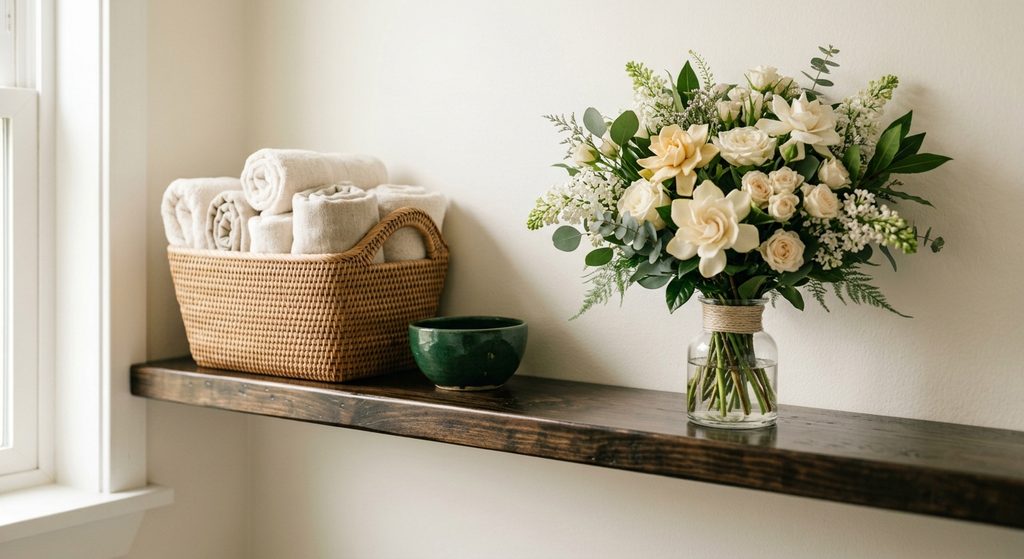
When you do buy one, sort first and measure the spot, then buy a single basket and test it for a week before ordering the matching set. Check the return policy too, since people tend to discover the wrong size at the worst possible moment. And if a basket needs a label to remind you what’s hiding inside, ask yourself whether that’s the thing you should be letting go of.
The basket can wait
Next time a basket lands in your cart, try asking two questions. What exactly is this holding, and where, specifically, will it go? If you can answer both, buy it with a clear conscience. If you can’t, you’ve probably found a postponed decision wearing a woven disguise, and it costs nothing to look at it for five minutes first.
Your room may well need storage. It may just need less stuff, or a different arrangement, or one proper rail where you’ve been using a chair. Knowing which one it is saves money, floor space, and the awkward moment of explaining to yourself why there are four baskets.
Leave a Reply